

Synthetic assets allow people to gain exposure to stocks, gold, currencies, and other assets without actually owning them.
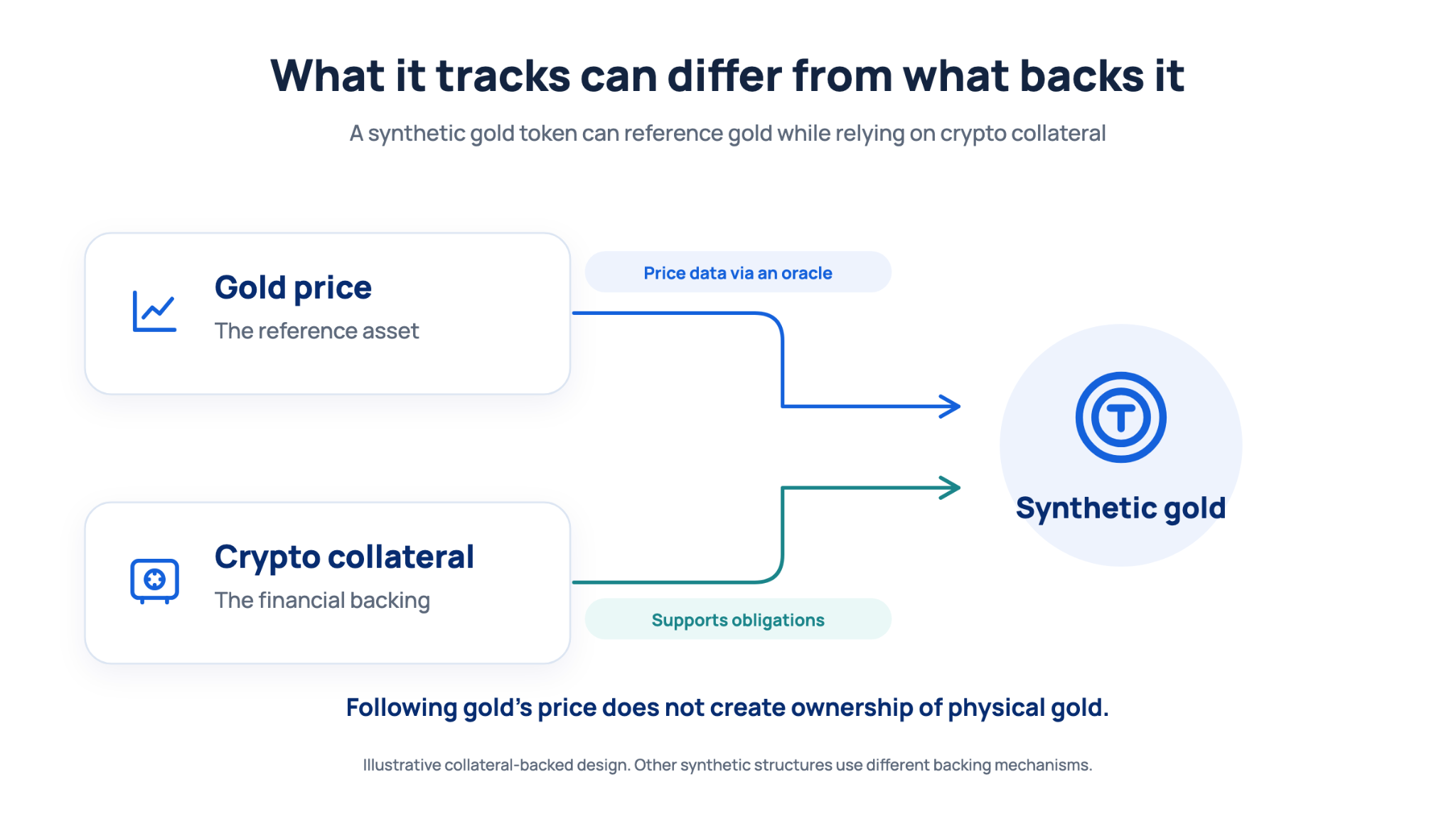
For example, someone could buy a blockchain token that follows the price of gold. If gold becomes more expensive, the token is designed to increase in value, too. Yet the person holding that token does not own any physical gold.
This is the basic idea behind synthetic assets in crypto. They use blockchain technology to recreate the financial performance of other assets, making it possible to trade their price movements through decentralized finance (DeFi) applications.
What Are Synthetic Assets in Crypto?
Synthetic assets are blockchain-based financial instruments designed to track the price or performance of another asset without requiring ownership of that underlying asset.
They are a type of financial derivative. A derivative is a financial product whose value depends on another asset, such as a stock, cryptocurrency, commodity, or market index.
In traditional finance, futures, options, and swaps are common examples of derivatives.
Blockchain-based synthetic assets serve a similar purpose. The difference is that they can use smart contracts to create, manage, trade, and settle financial exposure on a blockchain.
Synthetic assets are also commonly called synths.
For example:
- A synthetic Bitcoin asset tracks Bitcoin's price without requiring the holder to own BTC.
- A synthetic gold asset follows the price of gold without requiring physical gold reserves.
- A synthetic stock tracks a company's share price without giving its holder ownership of that company's shares.
Synthetic assets provide price exposure, not necessarily ownership rights.
How do synthetic assets work?
Most synthetic assets follow the same four steps.
- Lock collateral: You deposit crypto, such as ETH or a stablecoin, into a smart contract.
- Mint the synth: Once sufficient collateral is deposited, a smart contract can mint a synthetic token. The token is designed to track a particular asset, such as gold or Bitcoin.
- Track the price: An oracle, a service that brings outside data onto the blockchain, feeds in the real asset's price. The synth's value moves with it.
- Burn to exit: To unlock your collateral, you return (burn) the synths you minted.
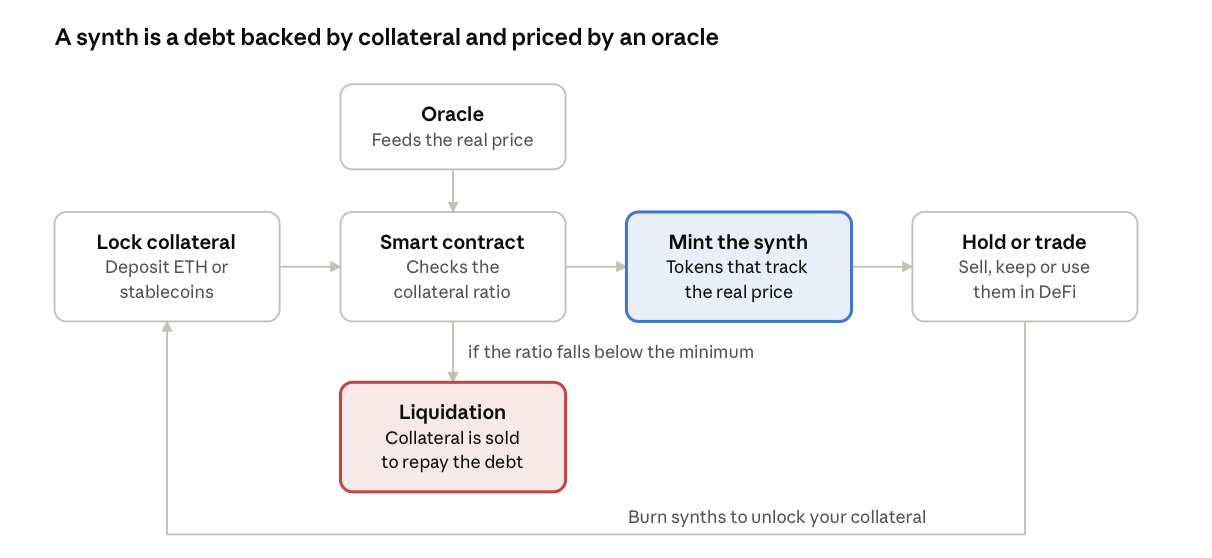
The oracle's price decides both how much you can mint and when liquidation starts.
Example
Suppose a synthetic gold token is designed to follow the price of gold.
You purchase $100 worth of this token.
If gold's price increases by 10%, your synthetic position should also increase by approximately 10%, assuming the token tracks its reference price accurately.
Your $100 position would then be worth approximately $110.
If gold's price falls by 10%, your position would instead be worth approximately $90.
In either case, you never actually own gold.
You simply hold a financial instrument whose value is linked to gold's performance.
This example assumes no leverage and excludes trading fees, funding costs, and price-tracking differences.
Keep in mind that creating a synthetic asset usually also creates a corresponding debt or obligation for the person supplying the collateral. To recover their collateral, they may need to repay that debt and burn the synthetic tokens.
Types of Synthetic Assets in Crypto
Synthetic assets can track many different financial markets.
| Type | What it tracks |
|---|---|
| Synthetic cryptocurrencies | Prices of Bitcoin, Ethereum, or other cryptocurrencies |
| Synthetic stocks | Prices of individual company shares |
| Synthetic commodities | Prices of gold, silver, oil, and other commodities |
| Synthetic currencies | Exchange rates or values of fiat currencies such as USD and EUR |
| Synthetic indexes | Performance of stock indexes or baskets of assets |
| Inverse and leveraged synthetics | Opposite or amplified movements of an underlying asset |
Examples of Synthetic Asset Protocols
Several DeFi protocols demonstrate different ways to create synthetic exposure.
Synthetix
One of the earliest major synthetic asset protocols. It introduced products such as sUSD, sBTC, and sETH. However, its legacy non-USD spot synths have been deprecated, and the protocol has shifted its focus toward perpetual futures trading on Ethereum.
Metronome Synth
A collateral-backed synthetic asset protocol that supports creating synthetic exposure to cryptocurrencies and other assets. Its documentation describes synthetic tokens such as msUSD and msETH.
GMX
A decentralized derivatives exchange with synthetic markets. For example, a market may track DOGE's price while using ETH and USDC as its backing collateral. Traders obtain exposure through derivative positions rather than owning the referenced DOGE.
Types of synthetic assets by design
| Design | How the price holds |
|---|---|
| Over-collateralized debt | Minters lock more value than they mint, and arbitrage keeps the price near the oracle |
| Delta-neutral hedge | Each deposit is paired with an equal short futures position, so gains and losses cancel out |
| Perpetual futures | Traders open long or short contracts on a price, settled in crypto, with no token of the asset |
Synthetic vs tokenized vs wrapped assets
These three get mixed up, even in top-ranking guides. The difference comes down to one question. Is a real asset held somewhere for you? With a synthetic asset, the answer is no.
| Synthetic asset | Tokenized asset | Wrapped asset | |
|---|---|---|---|
| What backs it | Crypto collateral or a hedge, not the asset itself | The real asset, held by a custodian | The original coin, locked by a custodian or bridge |
| Do you own the underlying? | No, you get price exposure only | You get a claim on the held asset, often without voting rights | You get a claim on the locked coin |
| Who you rely on | Smart contract, oracle, collateral | Issuer and custodian | Custodian or bridge |
| Example | USDe, HIP-3 perps, legacy Synthetix synths | xStocks, backed one-to-one by shares | WBTC, backed by bitcoin |
Why people use synthetic assets
Synthetic assets remove the middlemen that normally stand between a person and a market. Here is what that makes possible.
- Access: A crypto wallet can reach price exposure to US stocks, gold or forex without a local broker, where local rules allow it.
- Trading at any hour: Stock markets close at night and on weekends. Most onchain markets never close.
- Small amounts: You can buy a fraction of a share's price exposure, even with a few dollars.
- Easy shorting and hedging: Inverse synths and short perps let you profit from, or protect against, a price fall.
- Building blocks for DeFi: Synths are tokens, so other apps can use them as collateral, in lending markets or in trading pools.
Are synthetic assets regulated?
In the US, a synthetic stock token is treated as a separate security from the stock it tracks. On January 28, 2026, SEC staff published a statement on tokenized securities. It splits stock tokens into two groups.
- Issuer-sponsored tokens are issued by the company itself and represent the actual security.
- Third-party tokens are issued by someone else. A synthetic version tracks the stock's value but gives no ownership, only a claim against the issuer.
The statement says a synthetic stock token may count as a security-based swap. If it does, it cannot be sold to ordinary retail investors unless the token is registered and trades on a national securities exchange.
Rules differ by country, and many synthetic products block users from certain regions. Check what is allowed where you live. This is general information, not legal advice.
How Transak Helps Companies Offering Synthetic Assets
Companies offering synthetic stocks, commodities, or other blockchain-based financial products need an easy way for users to move money into and out of their platforms.
Transak provides the fiat-to-crypto payment infrastructure that makes this possible.
With Transak's on-ramp, users can purchase supported cryptocurrencies and stablecoins using credit cards, bank transfers, Apple Pay, and other local payment methods. These funds can then be used to access synthetic asset products on the platform.
Transak also provides off-ramp services, allowing users to convert supported crypto assets back into local currencies.
Through its white-label APIs, companies can integrate these payment flows directly into their applications while Transak handles KYC, payment processing, and compliance for the fiat-to-crypto transactions.
This allows companies to focus on building and managing their synthetic asset products without having to build payment infrastructure from scratch. The platform remains responsible for the synthetic products and their applicable regulatory requirements.
Building a synthetic asset platform? Explore Transak's payment infrastructure to simplify how users fund and withdraw from your application.
Conclusion
Synthetic assets make it possible to trade the financial performance of an asset without owning that asset directly.
By combining smart contracts, collateral, and market data, blockchain protocols can create synthetic exposure to cryptocurrencies, commodities, currencies, stocks, and other financial instruments.
Their main advantage is flexibility. They allow developers to build financial products that extend beyond directly buying, holding, and transferring assets.
However, synthetic exposure is not the same as ownership. Understanding the underlying collateral, pricing mechanisms, settlement rules, and legal rights is essential before using or building products around synthetic assets.
Frequently Asked Questions
Are synthetic assets backed by real assets?
Not necessarily. A synthetic gold token, for example, may be backed by cryptocurrency collateral rather than physical gold. Other synthetic products may use liquidity pools or hedged positions to meet their obligations.
Are synthetic assets the same as stablecoins?
No. Some stablecoins use synthetic mechanisms to track a fiat currency, but not all stablecoins are synthetic assets. Fiat-backed stablecoins such as USDC use a different reserve and issuance structure.
Can synthetic assets be traded 24/7?
Some blockchain-based synthetic products support around-the-clock trading. However, availability depends on the protocol, market liquidity, and price data. Products linked to traditional stock markets may face pricing limitations outside normal market hours.
Do synthetic stocks pay dividends?
Holding a synthetic stock does not automatically provide a right to receive dividends from the underlying company. Some synthetic products may account for dividends through their pricing or settlement terms, but this depends on the instrument.
Are synthetic assets legal?
Their legal treatment depends on the jurisdiction and product structure. Synthetic assets linked to stocks may qualify as securities or regulated derivatives, even when they are issued or traded on a blockchain.
