

[[key]]
- Payments only feel instant because businesses absorb hidden costs like prefunding, settlement delays, FX risk, and operational complexity behind the scenes.
- Over $4 trillion sits idle in pre-funded accounts globally, trapping capital, raising costs, and limiting access for smaller banks and emerging markets.
- PayFi treats payments as settlement itself, not messages, using stablecoins and programmable digital assets to move and settle value in real time.
- Stablecoin rails remove the need for prefunding, enable 24/7 cross-border settlement, and simplify treasury, reconciliation, and liquidity management.
- PayFi unlocks capital efficiency, predictable payment behavior, and programmable flows while fitting cleanly into existing banking, compliance, and payout systems.
[[/key]]
For most people today, payments feel instant. They initiate a transfer and the confirmation normally shows up in seconds. In reality, that is a manufactured experience.
Behind the scenes, businesses have made deliberate trade-offs to make payments look fast. They pre-fund accounts across geographies. They carry settlement risk on their balance sheets. They absorb delays, FX exposure, and reconciliation overhead so users never see it.
Those costs show up as trapped working capital, thinner margins, slower expansion into new markets, and complex operational stacks that only get harder to scale. [[widget crypto=(USDC)]]
Essentially, the speed at the user layer is often bought by inefficiency at the infrastructure layer.
PayFi, short for Payment Finance, fixes that by bringing the best traits of blockchain rails to traditional finance.
[[related text=(A Step-by-Step Guide to Blockchain Payments) link=(https://transak.com/blog/a-step-by-step-guide-to-blockchain-payments)]]
Prefunding: The Biggest Drag for Banks and Finance Apps
In our article on the correspondent banking system, we saw how money hops across multiple intermediaries before reaching its destination. Each hop introduces delay and adds cost.
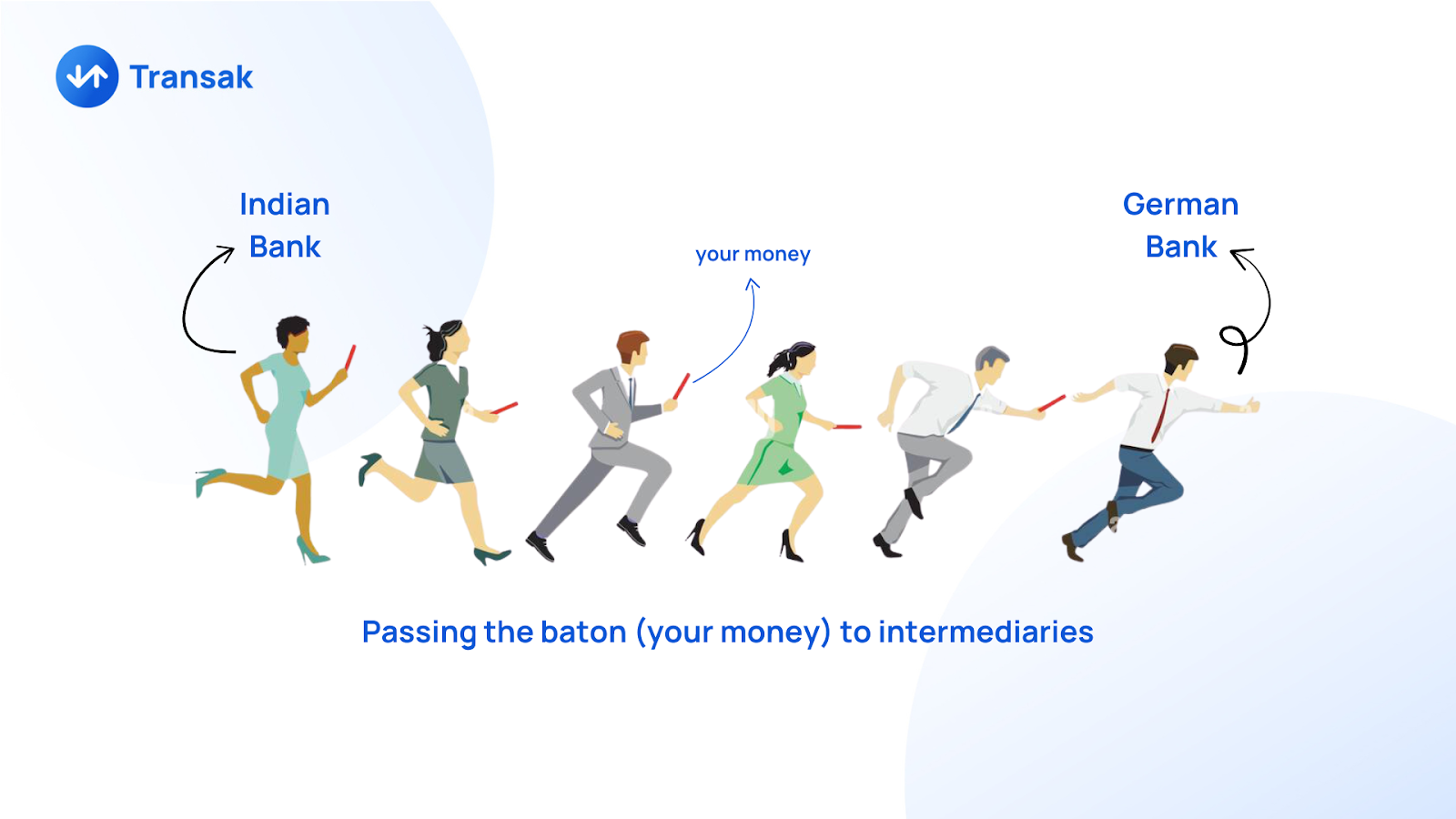
To keep the complex network running smoothly, banks maintain pre-funded accounts (called nostro accounts) in various foreign currencies across multiple countries.
These accounts act like fuel tanks for cross-border payments. Whenever a customer wants to send money abroad, the bank draws from its pre-funded balance in that foreign account to settle the transaction quickly.
While the system works well from a user’s standpoint, it is an enormous financial drag on the businesses that have to deal with it.
- Idle capital at scale: More than $4 trillion sits parked in pre-funded accounts worldwide, doing nothing except waiting for future payments.
- High costs for emerging markets: Smaller banks cannot afford large prefunding buffers, making cross-border payments into developing regions slower and more expensive.
- Liquidity trapped in silos: Funds are fragmented across currencies and geographies, with no real-time way to rebalance or reuse liquidity.
- Operational drag for businesses: Delayed settlements and capital on hold create an invisible tax on treasury, payroll, and global operations.
Defining PayFi (Payment Finance)
Payment Finance, or PayFi, is a new way to move money. It treats payments as a financial primitive, not just a messaging layer.
What does it mean to be a primitive and not a messaging layer?
Legacy payment systems work like messaging networks. One system sends a message saying “debit this account,” another sends a message saying “credit that account,” and the actual movement of value is reconciled later. The payment is essentially a promise that money will move, backed by trust, prefunding, or credit risk.
A financial primitive is something that exists natively in the system and does real work on its own. In PayFi, the payment is the settlement.
At its core, PayFi uses stablecoin rails and programmable digital assets to move value itself, in real time, with settlement and logic embedded directly into the payment.
So, PayFi is a model where payments move and settle value in real time using stablecoins and programmable digital assets, removing the need for prefunding, delayed settlement, and fragmented intermediaries.
Stablecoins as Payment Rails
Stablecoins change payments by changing what actually moves.
When a stablecoin transaction happens, money settles directly between parties on a shared ledger. There is no waiting. Settlement is native to the transaction itself.
This matters because settlement speed dictates how much capital must be parked, how much risk must be absorbed, and how complex a payments stack becomes as volumes scale.
Stablecoins operate 24/7, across borders, with predictable settlement behavior. A dollar-denominated stablecoin sent today behaves the same way whether it moves between two wallets in the same city or across continents.
Just as importantly, stablecoins are digital bearer assets. Ownership transfers directly with the transaction, without relying on intermediaries to update internal ledgers later.
In PayFi, stablecoins act as neutral settlement assets that sit above fragmented banking rails. They do not replace banks or payment providers, but they give fintechs a way to move value globally without inheriting the inefficiencies of legacy settlement infrastructure.
Also Read: How Neobanks Can Increase Profits Using Stablecoin Rails
What PayFi Brings to the Table
PayFi changes the economics and operating model of how payments are run.
Also Read: Embedded Stablecoin Payments: The Next Evolution in Digital Commerce
Unlocks capital efficiency
Because settlement happens in real time, businesses no longer need to park large balances across geographies just to keep payments moving. The same pool of liquidity can be reused continuously, reducing idle capital and improving balance sheet flexibility.
Reduces operational complexity
PayFi collapses multiple layers of payment processing into a single flow. Settlement, reconciliation, and reporting happen together, on a shared ledger. Fewer moving parts means fewer failure points, fewer exceptions, and less manual intervention as volumes grow.
Improves speed without trade-offs
Payments are not fast because someone absorbs the delay. They are fast because value actually moves. This removes settlement risk and makes payment behavior more predictable for treasury and finance teams.
Enables programmable payments
Logic can be embedded directly into the movement of funds, allowing conditional releases, automated splits, compliance checks, and real-time reporting. Payments stop being static transfers and become coordinated financial actions.
Real-World PayFi Use Cases
PayFi shows its real value where traditional payment infrastructure starts to bend under scale, geography, and capital constraints.
Cross-Border Payouts and Remittances
PayFi allows funds to settle directly on stablecoin rails instead of moving through layered correspondent networks. This reduces settlement time, removes the need for prefunded nostro accounts, and makes costs more predictable across corridors.
In practice, this is where infrastructure providers like Transak fit in. We enable global on- and off-ramps so stablecoin-based payouts can still connect cleanly to local banking systems and payment methods.
Treasury and Liquidity Management
With real-time settlement, treasury teams can stop over-allocating buffers just to manage uncertainty. Liquidity can be consolidated and redeployed dynamically rather than split across currencies and regions.
PayFi-native flows become especially powerful when paired with stablecoin access, conversion, and compliance tooling, allowing treasury operations to move between fiat and on-chain value without operational friction.
Merchant Settlement and Platform Payouts
Marketplaces, creator platforms, and gig economy apps benefit from instant or near-instant settlement, even across borders. Instead of batching payouts or delaying transfers to manage cash flow, PayFi enables direct value transfer as soon as work is completed or revenue is earned.
Here, embedded payout infrastructure and off-ramp capabilities ensure that on-chain settlement can still land seamlessly in a merchant’s preferred local currency when needed.
B2B and Embedded Finance Flows
In B2B payments, PayFi enables atomic settlement tied to invoices, delivery confirmation, or contract milestones. Payments move only when conditions are met, reducing disputes and reconciliation overhead while improving cash flow predictability.
This becomes far more practical when programmable payments are backed by compliant fiat-to-stablecoin and stablecoin-to-fiat rails that businesses can integrate without rebuilding their financial stack.
How PayFi Fits Into Existing Financial Systems
PayFi works precisely because it fits around and between existing systems.
Banks, PSPs, custodians, compliance tools, and accounting systems are not going away. What PayFi changes is the settlement layer they coordinate around. Instead of relying on delayed clearing and prefunded liquidity, PayFi introduces a real-time value layer that existing systems can plug into.
This matters for adoption. Fintechs can introduce stablecoin settlement selectively, starting with cross-border flows, treasury optimization, or specific payout corridors, while keeping familiar interfaces and controls intact.
PayFi also aligns well with regulatory and compliance requirements. Identity checks, transaction monitoring, reporting, and controls still live where institutions expect them to. The difference is that once a payment is approved, settlement is immediate and final, rather than deferred and reconciled later.
In practice, PayFi acts as a coordination layer. It connects legacy systems that were never designed to talk to each other in real time and gives them a shared source of truth for value movement.
Enable PayFi for Your App with Transak
PayFi works best when the underlying infrastructure disappears into the background. Users should experience fast, predictable payments without needing to understand stablecoins, wallets, or on-chain settlement.
Transak provides the connective tissue between fiat systems and stablecoin rails, allowing apps to adopt PayFi without rebuilding their payments infrastructure from scratch. Through a single integration, businesses can enable users to move value between local currencies and stablecoins, globally and compliantly.
In practice, Transak enables PayFi by making stablecoin rails usable at scale.
[[button text=(Integrate Transak) link=(https://transak.com/integrate-transak)]]
